
Types of Agile Methodology: Choosing the Right Fit to Supercharge Your Team Meetings
Excerpt:
In a fast-paced business world, where adaptability and efficiency are key to staying ahead, agile methodologies are more than just buzzwords. They’re essential frameworks that drive productivity and innovation. For companies with 40–70 employees, particularly those led by visionary executives, optimizing team meetings is a top priority. That’s where agile comes in.
In this blog post, we’ll dive deep into the various types of agile methodologies. We will explore how each can transform your team’s meetings from time-consuming to time-saving, goal-driven sessions. Whether you’re a Director, VP, or C-suite executive, understanding these methodologies can help align your teams more effectively and deliver measurable results. Let’s explore how you can leverage agile methodologies to make every meeting count—with the help of tools like Meeting For Goals.
I. Introduction
Agile methodology has become a cornerstone of modern business management. It helps teams adapt quickly, deliver value consistently, and build a culture of continuous improvement. While it started in software development, agile is now used across industries—from marketing and HR to executive leadership.
For growing companies with 40–70 employees, staying agile while scaling can be a challenge. Meetings often become longer and less productive. That’s where agile methods shine. They offer clear structures that keep discussions focused, outcomes measurable, and teams aligned.
This guide explores different types of agile methodologies and how each can improve your team meetings. We’ll cover popular frameworks like Scrum, Kanban, and Extreme Programming (XP), along with powerful alternatives like Lean, Feature-Driven Development (FDD), and Crystal.
At Meeting For Goals, we specialize in helping teams run better meetings. Our platform is built to align every discussion with strategic goals, track action items, and promote accountability. Whether you’re a Director or a C-level executive, this guide will help you select the right agile framework to elevate your team’s performance.
👉 Ready to start transforming your meetings? Sign up today at https://app.meetingforgoals.com/TenantRegistration/Register
2 Minute Video
Watch a 2 minute demo of our meeting management software in action
II. The Essence of Agile Methodology
To understand how agile improves meetings, it’s important to grasp what agile really means. Agile isn’t a single process. It’s a mindset—a set of values and principles that guide how teams work together.
A. Definition of Agile Methodologies and Core Principles
Agile methodologies are iterative and flexible approaches to managing work. They emphasize collaboration, customer feedback, and quick delivery. The Agile Manifesto, created in 2001, outlines four key values:
- Individuals and interactions over processes and tools
- Working software over comprehensive documentation
- Customer collaboration over contract negotiation
- Responding to change over following a fixed plan
These values translate into several key principles that can reshape how your team meets and collaborates:
- Customer Collaboration: Meetings are focused on value delivery, not just internal updates.
- Embracing Change: Agile teams adapt quickly. Meetings become dynamic, not rigid.
- Iterative Progress: Frequent check-ins replace long, infrequent meetings.
- Cross-Functional Teams: Meetings become hubs for collaboration across departments.
B. Importance of Agile in Modern Business Environments
Today’s business world moves fast. Markets shift, customer needs evolve, and internal priorities change often. Traditional top-down management can’t keep up. Agile methodologies offer a flexible structure that helps teams stay aligned and responsive.
Agile helps teams:
- Adjust quickly to new information
- Stay focused on delivering real value
- Build a culture of learning and improvement
When applied to meetings, agile makes a big difference. Instead of long, meandering sessions, you get focused, goal-driven discussions. With tools like Meeting For Goals, you can structure meetings to promote accountability and action.
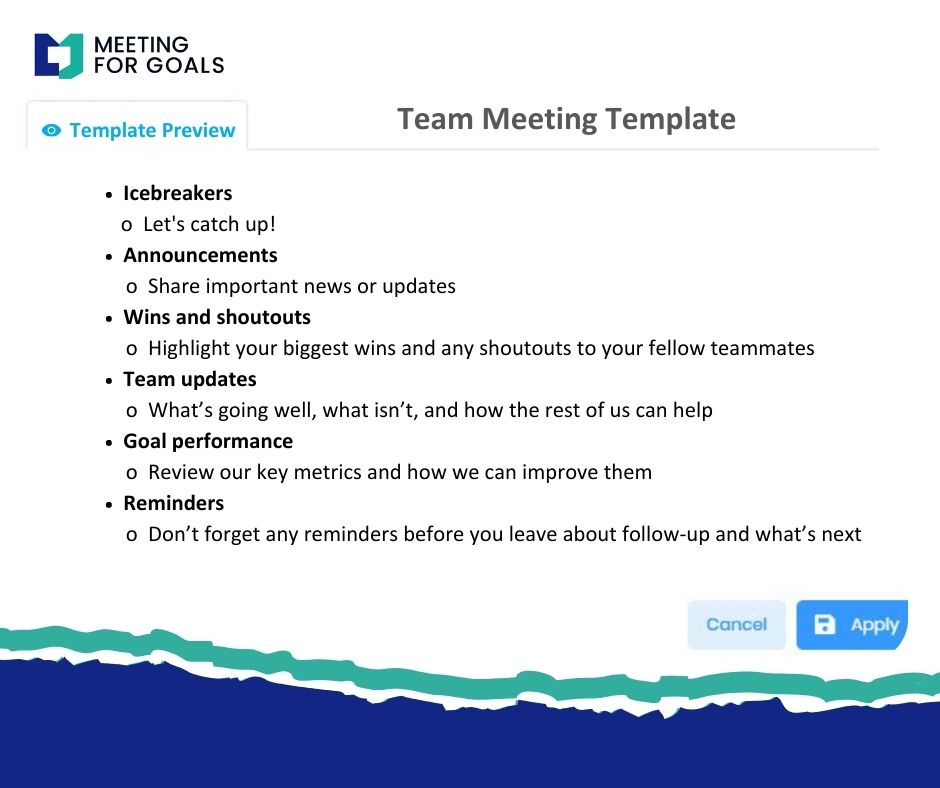
Want to simplify your meeting planning process? Check out our free meeting templates at https://meetingforgoals.com/meeting_templates
Adding an Agenda
How to add an agenda instantly on Meeting For Goals
III. Scrum: Structure Meets Flexibility
Scrum is one of the most popular agile frameworks. It’s widely used in software but also works well in marketing, product development, and operations. Scrum brings structure to team roles and meetings, making it ideal for growing teams.
A. Overview of Scrum Framework
Scrum breaks work into short cycles called Sprints, which typically last 1–4 weeks. The goal is to deliver a usable product or result at the end of each Sprint.
Scrum has three key roles:
- Scrum Master: Facilitates the process and removes roadblocks.
- Product Owner: Prioritizes work and represents the customer’s needs.
- Development Team: Delivers the work through collaboration.
It also includes four main types of meetings (called ceremonies):
- Sprint Planning: Sets goals for the Sprint and outlines the tasks.
- Daily Stand-up: A 15-minute check-in to discuss progress and blockers.
- Sprint Review: Showcases what was completed.
- Sprint Retrospective: Reflects on what went well and what can improve.
B. Benefits of Using Scrum in Team Meetings
- Improved Transparency and Accountability
Scrum meetings have clear purposes and outcomes. Everyone knows what to expect and what’s expected of them. This structure reduces confusion and increases ownership.
- Enhanced Focus and Flexibility
Time-boxed Sprints keep teams focused on short-term goals. If priorities shift, they can quickly realign at the next Sprint planning session. This is especially useful for executives managing multiple departments.
Scrum also helps reduce meeting fatigue. Instead of long weekly meetings, teams have short, focused touchpoints that keep everyone aligned and moving forward.
Meeting For Goals can help automate your Scrum meetings—track agendas, assign action items, and keep teams aligned with business goals.
IV. Kanban: Visualize and Optimize
Kanban is another agile framework, but it’s more flexible than Scrum. It focuses on visualizing work, limiting tasks in progress, and improving flow. It’s perfect for teams that need agility without rigid structures.
A. Introduction to Kanban Methodology
Kanban uses visual boards to map out work. Tasks are represented as cards and move through stages like “To Do,” “In Progress,” and “Done.”
Core principles of Kanban include:
- Visualizing Work: Everyone can see what’s being worked on and what’s next.
- Limiting Work in Progress (WIP): Prevents overload and reduces bottlenecks.
- Continuous Delivery: Work is delivered as soon as it’s ready—no need to wait for a Sprint.
B. How Kanban Improves Meeting Productivity
- Streamlined Communication and Reduced Bottlenecks
Kanban boards act as a shared reference point. Instead of status update meetings, teams can jump straight into solving problems and reassigning tasks. This saves time and boosts productivity.
- Facilitates Adaptation and Prioritization
Kanban allows for real-time changes. If something urgent comes up, it can be added to the board immediately. This makes Kanban ideal for fast-paced teams or departments juggling multiple priorities.
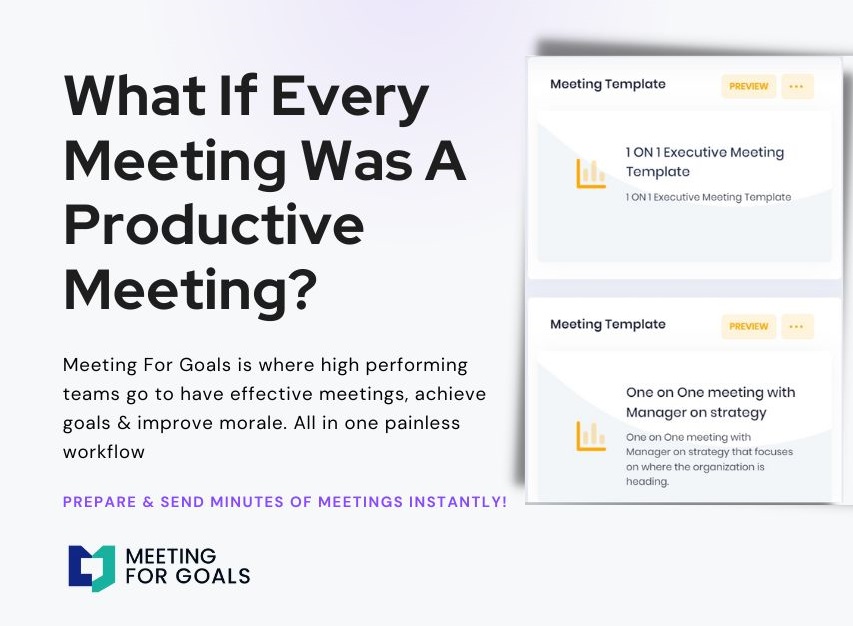
Meeting For Goals integrates well with Kanban. You can connect meeting outcomes to your workflow, making it easier to track progress and follow through on decisions.
V. Extreme Programming (XP): Engineering Excellence
XP is designed for technical teams, but its principles can benefit any team looking to improve collaboration and quality. It focuses on engineering best practices and frequent feedback.
A. Explanation of XP and Its Emphasis on Engineering Practices
XP encourages short development cycles, frequent releases, and constant testing. Key practices include:
- Continuous Integration: Code is integrated and tested regularly.
- Test-Driven Development (TDD): Tests are written before the code.
- Pair Programming: Two developers work together to write and review code.
B. Impact of XP on Team Dynamics and Meetings
- Enhancing Collaboration and Reducing Miscommunication
XP promotes constant feedback and teamwork. When applied to meetings, this means open discussions, faster decision-making, and fewer misunderstandings.
- Promoting a Culture of Feedback and Continuous Improvement
XP encourages regular retrospectives and feedback loops. These can be applied to your meetings to improve format, engagement, and outcomes over time.
With Meeting For Goals, you can collect feedback after each meeting and use it to iterate and improve—just like XP teams do with their code.
VI. Other Agile Methodologies
Beyond Scrum, Kanban, and XP, there are other agile frameworks that might suit your team better, depending on your goals and structure.
A. Brief Overview of Additional Agile Frameworks
- Lean Software Development:
Lean focuses on eliminating waste and maximizing value. Meetings are short and centered around solving problems or making decisions. Inspired by Lean manufacturing, it’s ideal for teams that want efficiency above all else.
- Feature-Driven Development (FDD):
FDD organizes work around specific features. It starts with a clear design and breaks work into small, manageable pieces. This makes meetings more focused on deliverables and timelines.
- Crystal Methodology:
Crystal is a family of agile methods tailored to team size and project complexity. It values people and interactions over rigid processes. Meetings are flexible and adapted to suit the team’s style and needs.
B. How Each Framework Contributes to Productive Meetings
- Lean: Keeps meetings short, focused, and value-driven.
- FDD: Structures discussions around specific features and deliverables.
- Crystal: Encourages adaptive meeting styles based on team dynamics.
Each of these frameworks can be powered by Meeting For Goals. Whether you need structured agendas or flexible templates, our platform helps you run better meetings.
Looking for a starting point? Browse our free meeting templates at https://meetingforgoals.com/meeting_templates
VII. Conclusion
Agile methodologies aren’t just for developers—they’re powerful tools for any team that wants to work smarter, faster, and more collaboratively. Whether you choose Scrum for its structure, Kanban for its flexibility, or XP for its focus on quality, agile can transform your meetings.
For companies with 40–70 employees, choosing the right agile methodology can lead to:
- Shorter, more effective meetings
- Increased accountability
- Better alignment with strategic goals
- A stronger culture of continuous improvement
At Meeting For Goals, we help you bring agile principles into every meeting. From templates and agendas to action tracking and feedback, our platform is built to make your meetings matter.
👉 Ready to level up your meetings? Sign up now at https://app.meetingforgoals.com/TenantRegistration/Register
👉 Learn more about how we support agile teams at https://meetingforgoals.com
👉 Want to explore more agile strategies? Check out this guide from Atlassian: https://www.atlassian.com/agile
👉 For a deeper dive into the Agile Manifesto, visit: https://agilemanifesto.org
With the right agile approach and the right tools, your meetings can become a catalyst for growth, innovation, and team success.