
In today’s fast-paced business world, time is money—and meetings need to deliver results. But too often, they become routine check-ins with no clear purpose or outcome. That’s where retrospective meetings come in.
In today’s fast-paced business world, time is money—and meetings need to deliver results. But too often, they become routine check-ins with no clear purpose or outcome. That’s where retrospective meetings come in. Whether you’re leading a software team or managing operations, retrospectives help your team reflect, adapt, and improve.
In this article, we’ll break down what a retrospective meeting is, why it matters, and how to run one effectively. We’ll also show you how tools like Meeting For Goals can turn your retrospectives into action-packed sessions that drive real change.
Looking to make your meetings more productive? Start by signing up for Meeting For Goals at this link and explore our free meeting templates at this link.
2 Minute Video
Watch a 2 minute demo of our meeting management software in action
What Is a Retrospective Meeting?
Let’s start with the basics. A retrospective meeting is a structured session where teams look back on a recent project, sprint, or work cycle. The goal is simple:
- Identify what went well.
- Identify what didn’t.
- Decide how to improve.
Unlike status meetings or progress updates, retrospectives focus on the process—not just the outcomes. It’s a time for open, honest reflection about how the team worked together, what challenges they faced, and how they can work better moving forward.
Originally popularized in Agile and Scrum frameworks, retrospectives are now used across industries—from marketing and HR to finance and operations. They’re especially useful for teams that want to build trust, improve collaboration, and boost performance.
Want to see how retrospectives differ from other meetings?
- Daily Stand-Ups: Quick updates on what each person is working on.
- Status Meetings: Focused on deliverables and timelines.
- Retrospectives: Focused on team dynamics, processes, and improvement.
Retrospectives are your team’s opportunity to grow—not just finish tasks.
Adding an Agenda
How to add an agenda instantly on Meeting For Goals
Why Retrospective Meetings Matter
Retrospectives aren’t just another meeting—they’re an investment in your team’s success. Here’s why they’re so valuable:
- Continuous Improvement: Retrospectives help teams learn from experience and make small, consistent changes. Over time, these improvements add up to big results. This concept aligns with the Agile principle of iterative development and the Lean philosophy of Kaizen.
- Team Reflection: Retrospectives give your team a voice. It’s a safe space to share thoughts, frustrations, and ideas. Questions such as how the team communicated, whether roles were clear, and if everyone felt supported are essential for building trust and morale.
- Insight Generation: A well-run retrospective can uncover insights you’d never get from a status report. With Meeting For Goals, you can capture insights in real time, categorize them, and assign follow-up tasks.
- Accountability and Cohesion: When teams identify action items and follow through, it builds accountability. Everyone knows their role in making improvements happen.
- Aligning with Organizational Goals: Retrospectives shouldn’t exist in a vacuum. Are your team’s improvements helping move the needle on KPIs? Meeting For Goals helps you link meeting outcomes to business objectives.
How to Structure a Retrospective Meeting
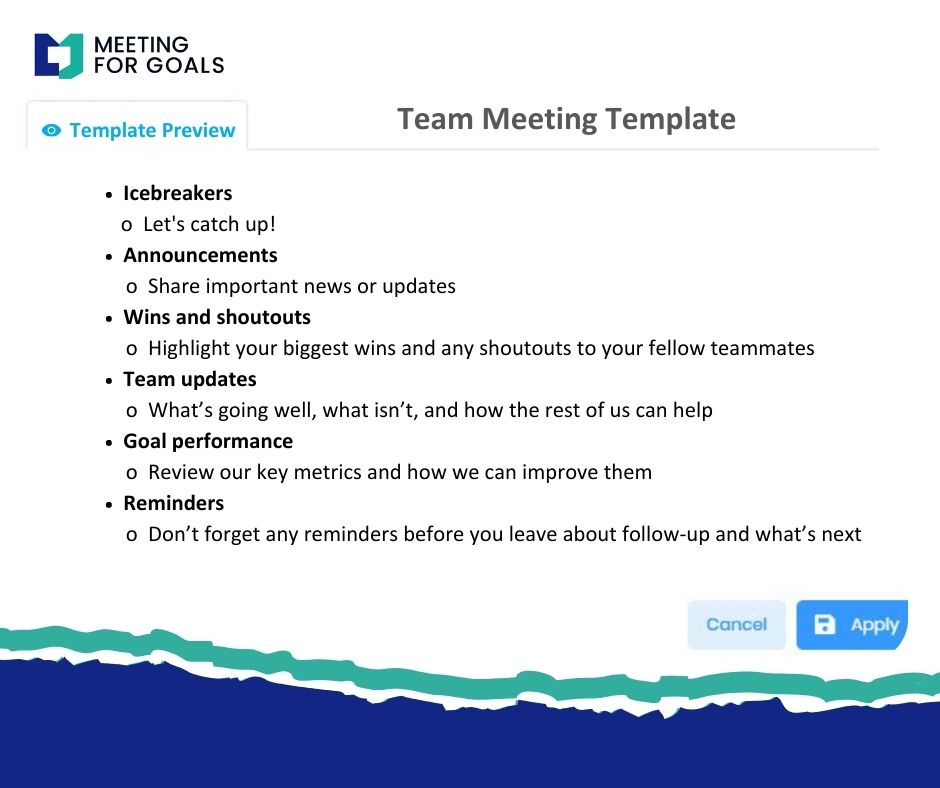
A successful retrospective doesn’t just happen. It takes planning, structure, and the right tools. Here’s how to run one that delivers real value:
- Choose a Framework: Start with a structure that guides the conversation. Popular options include:
- Start-Stop-Continue: What should we start doing, stop doing, and continue doing?
- 4Ls: What did we Like, Learn, Lack, and Long for?
- Mad-Sad-Glad: What made us mad, sad, or glad during the project?
- Sailboat: What helped us move forward (wind), what held us back (anchors), and what risks are ahead (icebergs)?
- Set the Stage: Create a safe space to let your team know this isn’t about blame—it’s about learning. Set rules like listening actively and speaking respectfully.
- Use the Right Tools: Digital tools can enhance your retrospective. Meeting For Goals helps you capture feedback instantly, group action items, and track follow-ups.
- Manage Time Wisely: Keep your meeting focused. An example schedule for a 45- to 60-minute retrospective is:
- Set context (5 minutes)
- Collect feedback (15 minutes)
- Group and discuss themes (15 minutes)
- Identify action items (10 minutes)
- Wrap up and review next steps (5 minutes)
- Follow Up: Ensure action items are documented, assigned, and reviewed in the next meeting. Meeting For Goals helps track tasks and send reminders.
Common Challenges—and How to Overcome Them
Even the best teams hit roadblocks. Here’s how to handle some of the most common retrospective challenges:
- Lack of Engagement: If your team is checked out, the meeting won’t be effective. Try these tips:
- Rotate facilitators to keep things interesting.
- Use interactive tools like polls or digital whiteboards.
- Allow anonymous input for more honest feedback.
- Avoiding Tough Topics: Create psychological safety by focusing on processes, not people. Use neutral language and remind the team that the goal is growth, not blame.
- Repeating the Same Issues: If the same problems keep coming up, you’re not following through. Use Meeting For Goals to track action items and celebrate wins to demonstrate change.
- Lack of Focus: Stick to your chosen framework. Assign a facilitator to keep things on track and on time.
- No Connection to Business Goals: Retrospectives should drive results. Tie your discussion back to company goals and KPIs.
Tips for Better Retrospectives
Want to take your retrospectives to the next level? Try these tips:
- Rotate Facilitators: Having different people lead the meeting keeps things fresh.
- Use Visual Aids: Charts, diagrams, or sticky notes can help visualize feedback and group ideas more effectively.
- Keep It Positive: Start with wins. Celebrate what went well before diving into problems.
- Invite the Right People: Ensure all contributors are present, but limit the number to keep conversations focused.
- Document Everything: Use Meeting For Goals to capture feedback, decisions, and action items.
Want to see how other teams run effective retrospectives? Check out this guide from Atlassian: this link.
How Often Should You Run a Retrospective?
It depends on your workflow. Agile teams usually run retrospectives at the end of each sprint—every two to four weeks. But you can adapt the frequency to fit your team:
- Weekly: Great for fast-moving teams or short projects.
- Bi-weekly: Ideal for Agile sprints.
- Monthly: Works well for non-technical teams.
- After major milestones: Useful for project-based work.
The key is consistency. Make retrospectives a habit—not a one-off.
Real-World Benefits of Retrospectives
Still not convinced? Here’s what teams gain from regular retrospectives:
- Faster problem-solving.
- Better team communication.
- Higher morale and trust.
- Increased accountability.
- Continuous process improvement.
- Stronger alignment with company goals.
According to a report by McKinsey, companies that embrace continuous learning and feedback outperform their peers. Retrospectives are a simple, powerful way to build that culture.
Conclusion: Make Your Meetings Matter
Retrospective meetings aren’t just a nice-to-have—they’re a must-have for any team that wants to grow and succeed. They help you reflect, learn, and improve—together.
With Meeting For Goals, you can transform your retrospectives from casual chats into strategic, results-driven sessions. Our platform helps you align meetings with your goals, track action items, and build a culture of accountability.
Ready to take your meetings to the next level? Sign up today at this link and explore our free meeting templates at this link.
For more insights and tools, visit Meeting For Goals and start running better meetings—starting now.