
OKR Tracking: Maximizing Team Performance with Meeting For Goals
In today’s fast-paced business world, high-performing teams aren’t just built on talent. They thrive on alignment, accountability, and execution. One of the most effective ways to achieve this is through OKRs (Objectives and Key Results). Setting OKRs is only the first step. The real magic happens when you track them consistently and weave them into your team’s meeting culture.
That’s where Meeting For Goals comes in. Our purpose-built meeting management software helps transform routine meetings into strategic, goal-driven sessions. If you’re a Director, VP, or executive leading a growing team, this guide will show you how OKR tracking can supercharge your team’s performance—and how Meeting For Goals can help you make it happen.
- 👉 Start transforming your meetings today: https://app.meetingforgoals.com/TenantRegistration/Register
- 🎯 Explore our free meeting templates to get started fast: https://meetingforgoals.com/meeting_templates
Clarity and alignment are the foundation of high-performing teams. The companies that consistently outperform their competitors are the ones that can turn strategy into action—again and again.
OKRs help teams align around shared goals and focus on measurable outcomes. But setting OKRs isn’t enough. If you only look at them once a quarter, they’re just words on a page.
The real power of OKRs lies in how you track and manage them. One of the best ways to do that is by integrating them into your meetings.
Why meetings? Because meetings are where decisions are made, priorities are clarified, and responsibilities are assigned. Unfortunately, many meetings are unfocused, too long, or lack follow-through.
Meeting For Goals changes that. It’s a meeting management platform designed for growing teams that want to get more done in less time. With built-in OKR tracking, it turns meetings into strategic sessions that align with company goals, boost accountability, and drive real results.
In this guide, we’ll break down:
- What OKRs are and why they matter
- How to integrate OKRs into your meeting culture
- Best practices for tracking OKRs during meetings
- How OKR tracking improves accountability
- How Meeting For Goals makes it all easier
Whether you’re managing a team of 40 or scaling toward 70 employees, this guide is packed with practical tips and tools to help you elevate your meetings—and your team performance.
2 Minute Video
Watch a 2 minute demo of our meeting management software in action
What Are OKRs and Why Do They Matter?
OKRs stand for Objectives and Key Results. The objective is your goal—what you want to achieve. The key results are how you’ll measure progress toward that goal.
Let’s say your objective is “Improve customer satisfaction.” Your key results might be:
- Increase Net Promoter Score (NPS) from 60 to 75
- Reduce average support response time by 30%
- Achieve a 95% customer satisfaction rating on support tickets
This structure gives your team a clear direction and measurable outcomes. Everyone knows what success looks like and how their work contributes.
OKRs are simple, but powerful. Unlike traditional performance metrics or vague mission statements, they bring focus and clarity. They also foster alignment—especially in companies with 40–70 employees, where teams are growing fast and need to stay connected.
At this size, it’s easy for departments to operate in silos. OKRs help break down those walls. They encourage cross-functional collaboration and shared accountability.
They’re also motivating. When team members see how their work ladders up to company goals, they feel more engaged and valued. But here’s the thing: OKRs only work if you track them. If you set them at the beginning of the quarter and forget about them, they won’t drive performance.
That’s why tracking OKRs—especially in meetings—is critical. Want to see how this works in action? Check out our free meeting templates designed to integrate OKRs into your workflow: https://meetingforgoals.com/meeting_templates
Adding an Agenda
How to add an agenda instantly on Meeting For Goals
How OKR Tracking Turns Meetings Into Performance Drivers
Let’s face it—most meetings could be better. They’re often too long, lack focus, and don’t lead to real action. But meetings don’t have to be a waste of time. When done right, they can be powerful tools for alignment, decision-making, and accountability.
The secret? Make OKRs part of the conversation. When OKRs are integrated into your meeting agenda, everything changes. The conversation shifts from vague updates to progress on key goals. Everyone knows what’s important, who’s responsible, and what needs to happen next.
For example, let’s say your marketing team has an objective to “Increase brand awareness.” Key results might include:
- Grow LinkedIn followers by 25%
- Secure 10 media placements
- Boost website traffic by 20%
In your weekly team meeting, each owner gives a quick update on their key result. If something’s off track, the team discusses how to fix it. If something’s working, you double down. This keeps everyone aligned and focused. It also makes meetings shorter and more productive.
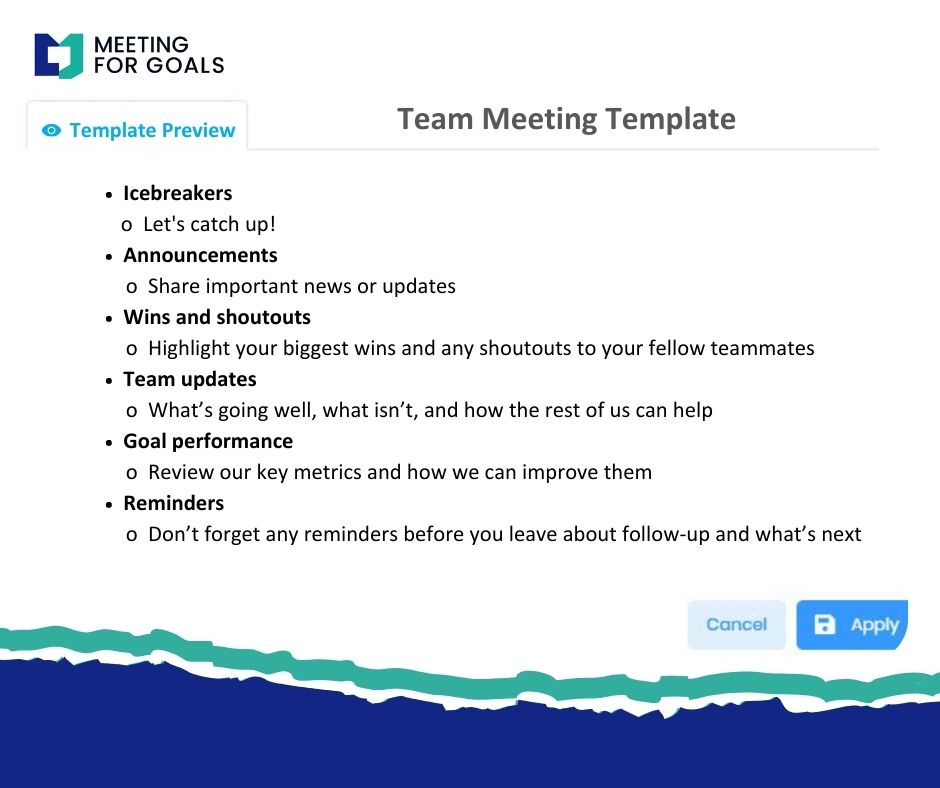
Meeting For Goals takes this to the next level. You can attach OKRs directly to your meeting agenda, track progress in real time, and assign follow-up actions—all in one place. No more switching between spreadsheets, docs, and project management tools. Everything is streamlined.
Want to learn more about how to run results-driven meetings? Visit https://meetingforgoals.com for tips and tools.
Best Practices for Tracking OKRs During Meetings
OKR tracking isn’t just about checking boxes. It’s about making sure your team is moving in the right direction—and doing it together. Here are six best practices to help you track OKRs effectively in your meetings:
- Set SMART OKRs: SMART stands for Specific, Measurable, Achievable, Relevant, and Time-bound. Avoid vague goals like “Do better in sales.” Instead, try “Increase Q3 revenue by 15%.” Clear OKRs make it easier to track progress and drive results.
- Make OKRs a Regular Agenda Item: Don’t let OKRs collect dust. Make them a standing item in your weekly or bi-weekly meetings. Even a 10-minute check-in can keep goals top-of-mind and maintain momentum.
- Use Visual Dashboards: A picture is worth a thousand words. Visual dashboards—like the ones in Meeting For Goals—show progress at a glance. Use traffic light indicators (green, yellow, red) or progress bars to make it easy to see what’s on track and what needs attention.
- Assign Clear Owners: Every key result should have a clear owner. This person is responsible for tracking progress, flagging issues, and driving outcomes. During meetings, they give brief updates and ask for support if needed.
- Document and Follow Up: Meeting notes should capture key updates, decisions, and action items. Meeting For Goals automatically generates summaries and tracks follow-ups, so nothing falls through the cracks.
- Use a Dedicated Tool: Trying to manage OKRs with spreadsheets and email is a recipe for frustration. Use a tool like Meeting For Goals to streamline the process. It’s built specifically for teams that want to align meetings with goals.
For more ideas on how to run effective meetings, check out this helpful guide from Harvard Business Review: https://hbr.org/2016/03/what-everyone-gets-wrong-about-meetings
How OKR Tracking Builds Accountability
One of the biggest benefits of OKR tracking is that it creates a culture of accountability. When goals are clear and progress is visible, people step up. They take ownership. They follow through.
Here’s how it works:
- Clear expectations: OKRs define what success looks like. Everyone knows the goal and how it will be measured.
- Regular check-ins: When you review OKRs in meetings, you’re reinforcing those expectations. Team members know they’ll be asked for updates, which encourages consistency.
- Ownership: Each key result has an owner. This person is responsible for moving it forward and reporting on progress.
- Transparency: Everyone can see how the team is doing. If something’s off track, it’s addressed early. If someone needs help, the team can jump in.
Meeting For Goals makes this easy. You can assign key results to individuals, track updates in real time, and document decisions right in the platform. It also helps build leadership skills. When team members take ownership of key results, they learn to lead projects, solve problems, and drive outcomes.
For executive leaders, it provides visibility. You can quickly see where the team stands, who’s excelling, and where support is needed. Want to see how this works? Try Meeting For Goals for free: https://app.meetingforgoals.com/TenantRegistration/Register
Real-World Example: Using OKRs in Weekly Meetings
Let’s walk through a quick example. Imagine you lead a product team at a SaaS company. Your objective is “Improve product adoption.” Your key results are:
- Increase daily active users (DAUs) by 20%
- Reduce churn by 15%
- Launch 3 new onboarding tutorials
Each key result is owned by a different team member. In your weekly meeting:
- The product manager reports on DAUs and shares a new feature that’s driving engagement.
- The customer success lead shares feedback from churned users and proposes a new retention strategy.
- The content designer shows progress on the tutorials and asks for feedback.
All of this happens in 20 minutes. Everyone’s aligned, blockers are addressed, and next steps are clear. Because you’re using Meeting For Goals, all updates, action items, and decisions are documented automatically. This is what high-performance meetings look like.
Conclusion
In today’s competitive landscape, success isn’t just about working hard. It’s about working smart. OKRs give you a clear path to success. But to unlock their full potential, you need to track them consistently and make them part of your team’s daily rhythm.
That’s where your meetings come in. When meetings are aligned with OKRs, they become powerful tools for performance, accountability, and growth. They help your team stay focused, move faster, and achieve more.
Meeting For Goals is designed to help you make this shift. With built-in OKR tracking, action item management, and automated summaries, it turns your meetings into engines of execution.
If you’re ready to stop wasting time in meetings and start driving results, now’s the time to act.
- ✅ Start your free trial today: https://app.meetingforgoals.com/TenantRegistration/Register
- 📂 Browse our free meeting templates to get started fast: https://meetingforgoals.com/meeting_templates
- 🌐 Learn more about how we help teams perform better: https://meetingforgoals.com
Because when your meetings are aligned with your goals, your team doesn’t just meet—they achieve.