
Introduction
In today’s fast-paced business world, effective team discussions are more important than ever. For companies with **40–70 employees**, especially those led by ambitious executives aiming for **operational excellence**, every meeting should drive results. Unfortunately, many teams are stuck in a cycle of long, unproductive meetings that lack **focus**, **accountability**, and **alignment**.
That’s where **Meeting For Goals** comes in. Our meeting management software streamlines discussions, aligns meetings with company goals, and drives real action. In this article, we’ll show you how to transform your team meetings into productive, goal-driven conversations.
In high-performing organizations, time is one of the most valuable resources. Every minute in a meeting should move your business forward. But for many companies—especially those with 40 to 70 employees—meetings often become time-wasters instead of value-drivers.
Team discussions are the core of collaboration, innovation, and decision-making. When executed properly, they create alignment, accountability, and momentum. But when they’re mismanaged, they lead to confusion, frustration, and wasted time.
That’s why Meeting For Goals was built. Our meeting management software helps high-performing teams run shorter, more focused meetings. It aligns every discussion with company goals, assigns responsibilities clearly, and ensures follow-through.
- Key benefits of Meeting For Goals:
- Shorter meetings with better outcomes
- Clear alignment with business objectives
- Improved accountability and task ownership
- Streamlined workflows that save time and reduce stress
This article is for directors, VPs, presidents, and C-suite leaders ready to elevate team performance. We’ll walk you through the common meeting challenges and how to solve them using proven strategies and the power of Meeting For Goals. Start making meetings count—sign up today at Meeting For Goals.
2 Minute Video
Watch a 2 minute demo of our meeting management software in action
The Challenges of Team Discussions
Even with the best intentions, many team discussions don’t deliver results. For mid-sized companies, this can be costly. Miscommunication, lack of focus, and poor time management often lead to:
- Missed deadlines
- Disengaged teams
- Stalled progress
Let’s break down the most common challenges:
- Lack of Focus: Meetings often start with a goal but quickly go off track. Without a clear agenda or someone guiding the conversation, discussions become scattered and ineffective.
- Poor Time Management: Time is frequently wasted on minor issues. Long debates with no resolution drain energy and reduce productivity. This leads to meeting fatigue and frustration.
- Unclear Objectives: If the purpose of a meeting isn’t clear, it’s hard for team members to contribute meaningfully. Ambiguity leads to confusion and makes it difficult to measure success.
- Lack of Accountability: Even when decisions are made, they often aren’t followed through. Without assigning clear responsibilities and deadlines, tasks fall through the cracks.
- Diminished Morale: Nothing kills morale like a two-hour meeting that accomplishes nothing. When employees feel their time is being wasted, engagement drops, and negativity spreads.
Real-Life Example: A 60-person tech company held weekly team meetings that dragged on for hours. Without a clear agenda, conversations veered off-topic. Responsibilities weren’t assigned, and deadlines were missed. Over time, team morale dropped, and productivity suffered. Sound familiar? It doesn’t have to be this way.
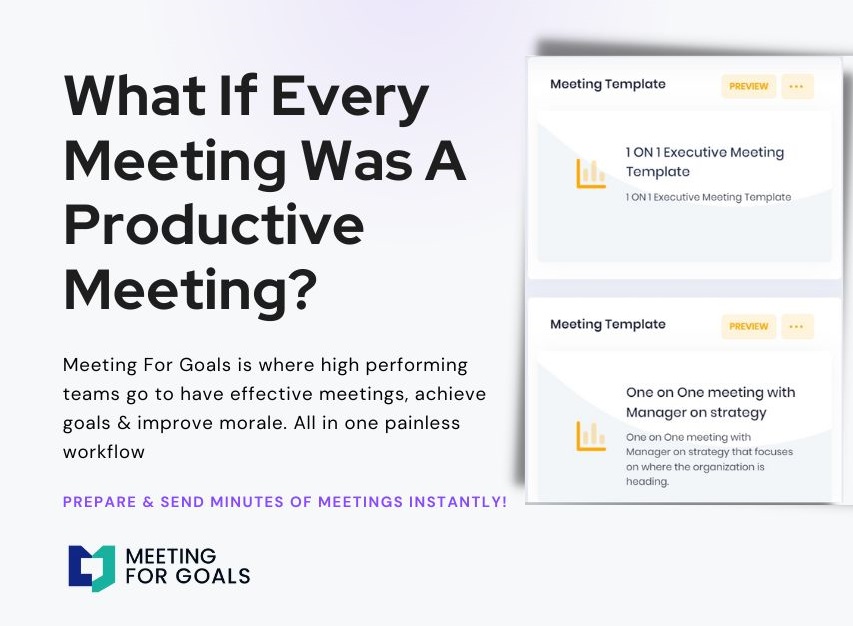
Meeting For Goals helps teams avoid these pitfalls. With tools for setting agendas, tracking time, and assigning action items, our platform ensures every meeting is purposeful and productive. Check out our free meeting templates to get started: Meeting Templates.
Adding an Agenda
How to add an agenda instantly on Meeting For Goals
Setting Clear Objectives for Discussions
One of the easiest ways to improve your meetings is by setting clear objectives. Without a defined purpose, discussions can drift and lose direction. A strong objective keeps everyone focused and aligned.
Why Objectives Matter: Objectives give your meeting a reason to exist. They help team members understand what they’re working toward and how their input contributes to the bigger picture. For organizations with 40–70 employees, where cross-functional collaboration is common, alignment is key. A clear objective ensures everyone is pulling in the same direction.
Use the SMART Framework: To make your objectives more effective, follow the SMART model:
- Specific: Define exactly what the meeting will cover.
- Measurable: Know what success looks like.
- Achievable: Keep it realistic within the meeting’s timeframe.
- Relevant: Connect the objective to business goals.
- Time-bound: Set a deadline for outcomes.
Example: Instead of saying, “Let’s talk about marketing,” try: “Finalize the Q3 content calendar and assign responsibilities to the content team by the end of this meeting.”
Align with Company Goals: When your meeting objectives support your company’s larger strategy, every discussion becomes more meaningful. This connection increases engagement and drives better outcomes. Meeting For Goals makes this easy. You can link each meeting to specific business objectives, ensuring alignment across your organization.
Tips for Setting Objectives:
- Include the objective in your calendar invite or agenda.
- Reiterate the goal at the start of the meeting.
- Use the objective to guide decision-making.
- Review progress against the objective at the end.
By setting SMART objectives, your team can stay focused, make better decisions, and drive real progress. For more on effective goal setting, check out this guide from Harvard Business Review: Setting Goals That Work.
Structuring Effective Team Discussions
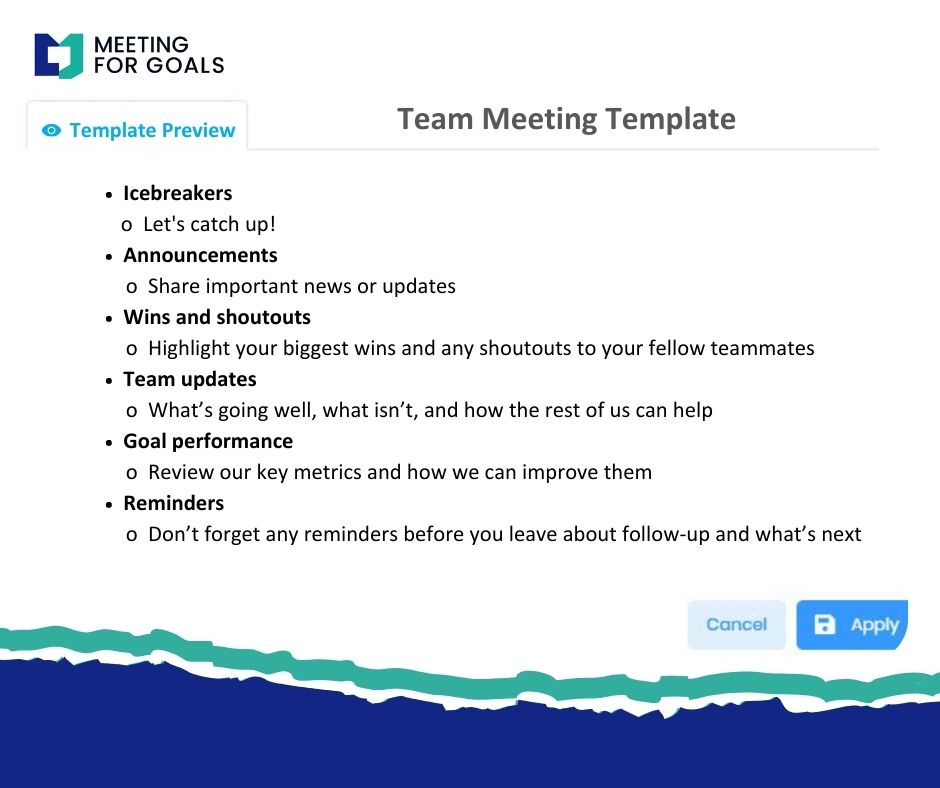
Even with a clear objective, meetings can fall apart without structure. A well-structured meeting ensures every minute is used wisely and leads to action.
The Anatomy of a Great Meeting:
- Pre-Meeting Preparation:
- Share the agenda and objective in advance
- Assign roles (facilitator, note-taker, timekeeper)
- Ask participants to review materials beforehand
- Opening (5–10 minutes):
- Reiterate the meeting objective
- Review the agenda
- Set expectations for participation
- Core Discussion (30–45 minutes):
- Stick to the agenda
- Timebox each topic
- Encourage focused, respectful dialogue
- Action Planning (10–15 minutes):
- Summarize key decisions
- Assign action items with clear owners and deadlines
- Clarify next steps
- Closing (5 minutes):
- Recap outcomes
- Get feedback on the meeting
- Confirm the next meeting date
Tools to Stay on Track:
- Timeboxing: Allocate time to each topic to avoid overruns.
- Moderation: Use a facilitator to guide the discussion.
- Visual Aids: Use shared docs or whiteboards for clarity.
Meeting For Goals includes built-in tools for all of this—timers, role assignments, collaborative agendas, and more.
Benefits of Structured Meetings:
- Shorter, more focused discussions
- Better participation and clarity
- Stronger decisions and follow-through
- Less stress and wasted time
Want to implement this structure right away? Use one of our free templates at Meeting Templates.
Enhancing Accountability and Responsibility
Accountability is what turns talk into action. Without it, meetings become echo chambers—ideas are shared, but nothing gets done.
Why Accountability Matters: When people know they’re responsible for specific outcomes, they’re more likely to follow through. It builds trust, improves execution, and keeps projects moving forward.
Assign Clear Roles:
- Facilitator: Keeps the conversation on track.
- Timekeeper: Manages the clock.
- Note-taker: Captures key points and action items.
But don’t stop there. Assign ownership of decisions and tasks. Be specific—use names, not departments.
Example: Instead of “Marketing will handle it,” say “Sarah will draft the email campaign by Friday.”
Track Progress: Use tools to monitor task completion. Follow up in future meetings to review progress. This keeps everyone accountable and creates a feedback loop.
Create a Culture of Responsibility:
- Recognize people who follow through.
- Encourage team members to hold each other accountable.
- Make action items visible to everyone.
How Meeting For Goals Helps:
- Assign tasks during the meeting with deadlines.
- Track progress and send reminders.
- Generate automatic meeting summaries with responsibilities.
This kind of transparency boosts execution and morale. When people see that their work matters—and that it’s being tracked—they’re more motivated to deliver. For more on building accountability in teams, check out this article from Forbes: 14 Ways to Build a Culture of Accountability.
Conclusion
Team discussions are a powerful tool—but only if they’re done right. Without clear goals, structure, and accountability, meetings can drain time and energy. But when managed effectively, they can boost alignment, productivity, and morale.
Meeting For Goals is your partner in making meetings matter. Our software helps teams:
- Run shorter, more focused meetings
- Align discussions with company goals
- Assign and track responsibilities
- Save time and improve morale
By applying the strategies in this article—setting **SMART objectives**, structuring discussions, and fostering **accountability**—you can take your team’s performance to the next level. Don’t let another unproductive meeting go by.
Start transforming your team discussions today:
👉 Sign up now at Meeting For Goals
👉 Explore our free meeting templates at Meeting Templates
👉 Learn more at Meeting For Goals
Let’s make meetings matter again.