
Agenda and Minutes of Meeting Example: How to Run Productive Meetings That Align with Company Goals
Running effective meetings is a hallmark of high-performing teams. Yet, many organizations still struggle with long, unfocused discussions. These lead to unclear outcomes and wasted time. The key to transforming your meetings lies in two often-overlooked tools: a well-crafted agenda and clearly documented meeting minutes. In this blog, we’ll explore real-world agenda and minutes of meeting examples, best practices, and how Meeting For Goals software can empower your team to run efficient, goal-aligned meetings that drive results. Start transforming your meetings today: Sign up for free at Meeting For Goals and explore our free meeting templates to get started.
I. Introduction
In today’s fast-paced business world, time is money. Meetings can either be a smart investment or a costly drain. For companies with 40 to 70 employees, especially those led by Directors, VPs, and C-suite executives, optimizing internal operations is key to staying ahead. One of the most overlooked opportunities for improvement? Meetings.
Poorly run meetings waste time, lower morale, and delay decisions. On the flip side, productive meetings foster alignment, accountability, and momentum toward your company’s goals. The difference between the two often comes down to how a meeting is planned and documented. That’s where Meeting For Goals steps in. Our meeting management software is built for high-performing teams that want to run shorter, more focused meetings aligned with strategic goals.
With tools to streamline agendas, assign tasks, and document minutes, we turn meetings into action. In this blog, you’ll learn:
- How to design agendas that keep meetings focused
- How to document minutes that drive follow-through
- How to use Meeting For Goals to simplify the entire process
Let’s dive into how to make every meeting count.
2 Minute Video
Watch a 2 minute demo of our meeting management software in action
II. Understanding the Purpose of an Agenda
An agenda is more than a checklist—it’s your meeting’s game plan. Think of it like a recipe. Without it, you risk missing ingredients, wasting time, and ending up with a result no one’s happy with. A great meeting agenda does four key things:
- Clarifies the meeting’s purpose
- Lists discussion topics with time estimates
- Assigns roles and responsibilities
- Prepares participants to contribute meaningfully
Let’s break it down.
Meeting Objectives
Start with a clear goal. Do you need to make a decision? Review progress? Solve a problem? Stating the objective helps everyone understand why they’re there—and what success looks like.
Topics and Time Allocations
Each topic should have a time limit. This keeps the meeting moving and ensures that important issues don’t get shortchanged.
Participants and Responsibilities
Who’s leading each topic? Who needs to give input? Assigning roles makes sure everyone knows what’s expected.
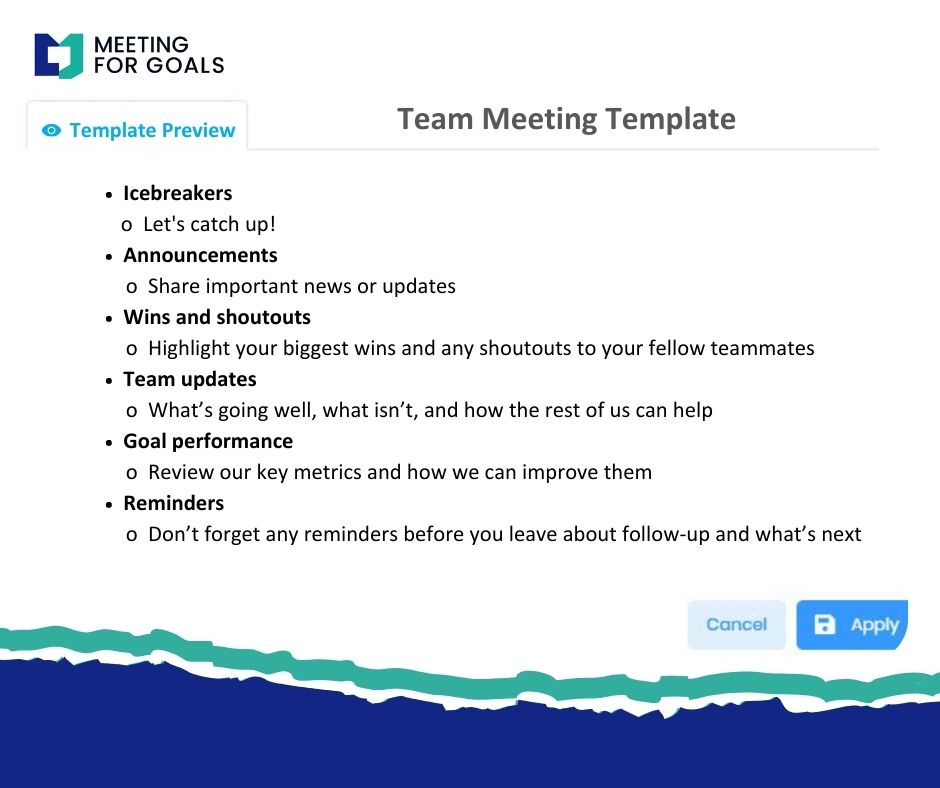
Here’s a sample agenda for a weekly team sync:
Weekly Team Sync Agenda – Monday 10:00 AM – 10:45 AM
- Welcome & Quick Wins (5 mins) – Led by Team Lead
- Project Updates (15 mins) – Each member shares progress
- Roadblocks & Dependencies (10 mins) – Open discussion
- Action Items Review (10 mins) – Assign and confirm tasks
- Closing & Next Steps (5 mins) – Recap and Q&A
This format keeps things tight, focused, and productive. Even better? When you use Meeting For Goals, you can link each agenda item to a specific company objective or KPI. That way, your meetings don’t just talk about work—they move your business forward. For more structured examples, check out our free meeting templates.
Adding an Agenda
How to add an agenda instantly on Meeting For Goals
III. Best Practices for Creating an Effective Meeting Agenda
Creating a solid agenda isn’t just about formatting—it’s about intention and collaboration. Here are some proven tips to help you build agendas that get results:
- Involve Your Team: Don’t build the agenda alone. Ask participants for input ahead of time. Use a shared doc or a quick survey to gather suggested topics. This ensures the agenda reflects what really matters.
- Match the Agenda to the Meeting Type: Different meetings need different styles. Here are a few examples:
- Team Standup: Quick check-in meetings (usually daily). Agenda: Yesterday’s work, today’s plan, blockers.
- Brainstorming Session: More open-ended and creative. Agenda: Problem statement, idea generation, next steps.
- Strategic Planning Meeting: Big-picture discussions. Agenda: KPI review, market analysis, strategic priorities.
- Prioritize and Timebox: Rank agenda items by importance. Assign time slots to each topic. If time runs out, lower-priority items can be moved to the next meeting.
- Share the Agenda Early: Send the agenda at least 24 hours in advance. This gives everyone time to prepare and show up ready to contribute. With Meeting For Goals, you can automatically attach agendas to calendar invites and team dashboards.
- Build in Flexibility: Leave a little room for unexpected topics. Add a “parking lot” section for off-topic ideas that can be revisited later.
- Iterate and Improve: Agendas aren’t one-size-fits-all. After each meeting, review what worked and what didn’t. Meeting For Goals includes analytics that show which agenda items ran long or sparked the most discussion—so you can refine over time.
By following these best practices, you’ll run meetings that are more efficient, more focused, and more aligned with your team’s goals. For more strategies, check out Harvard Business Review’s guide to running effective meetings.
IV. The Importance of Meeting Minutes
Meeting minutes are your team’s memory. They capture what was discussed, what was decided, and what needs to happen next. Without them, it’s easy for tasks to slip through the cracks—especially in fast-paced teams juggling multiple projects.
So what exactly are meeting minutes? They’re written summaries of the key points from a meeting. They include:
- Who attended
- What was discussed
- What decisions were made
- What actions were assigned (and to whom)
Why are they important?
- They document decisions for future reference.
- They help track progress on tasks.
- They hold people accountable.
- They keep absent team members in the loop.
Here’s a quick example:
Action Items from Marketing Strategy Meeting – March 12
- Jane to draft Q2 campaign outline by March 20
- Tom to analyze competitor data by March 18
- Sarah to schedule follow-up meeting for March 25
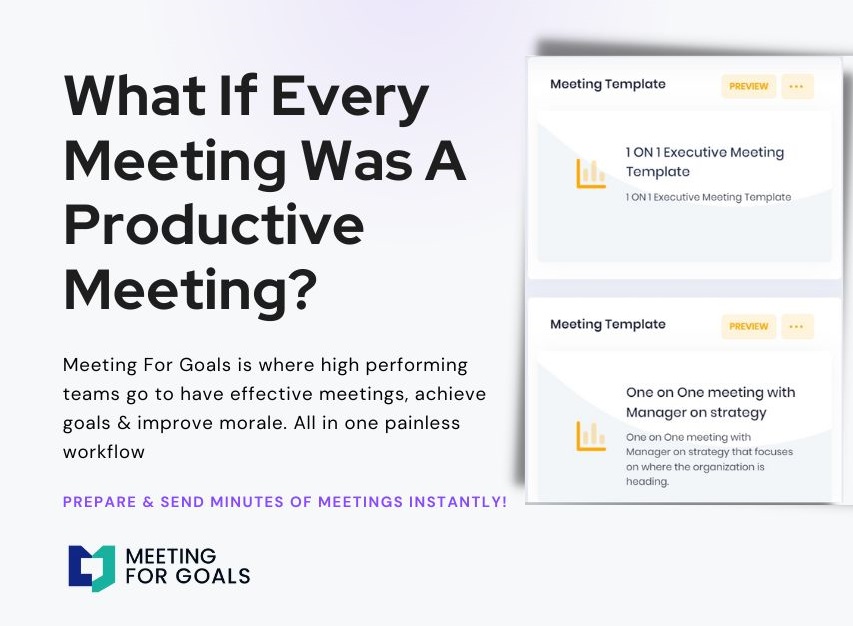
With Meeting For Goals, you can tag agenda items with action items and assign them in real-time. The platform automatically generates meeting minutes—so nothing gets lost or forgotten. Want to see how it works? Start your free trial here.
V. Best Practices for Documenting Meeting Minutes
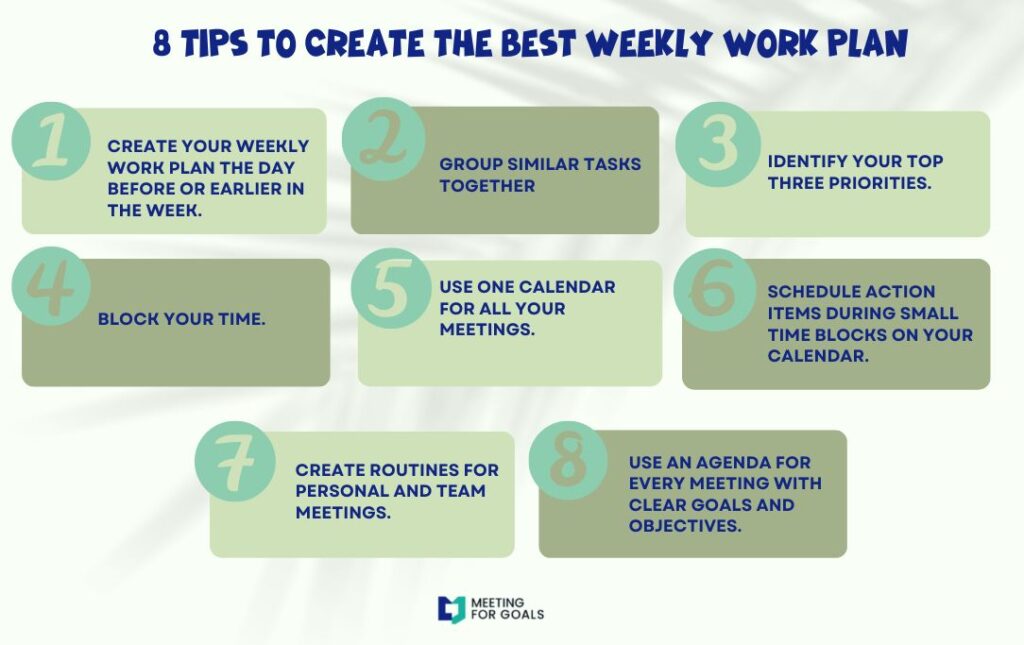
Great meeting minutes are clear, concise, and actionable. Here’s how to make yours count:
- Use a Consistent Template: Standardize your format. Every set of minutes should include:
- Meeting title and date
- List of attendees
- Summary of each agenda item
- Key decisions made
- Action items with owners and deadlines
This makes it easy for everyone to find what they need.
- Assign a Note-Taker: Choose one person to take notes. This ensures consistency and frees others to focus on the discussion. You can rotate this role or use Meeting For Goals to automate the process.
- Focus on Outcomes: Don’t try to capture every word. Instead, focus on what was decided and what needs to happen next. Use bullet points to keep it clear and skimmable.
- Finalize Minutes Quickly: Review and polish your notes right after the meeting while everything’s still fresh. Meeting For Goals helps you generate and share minutes instantly.
- Distribute Within 24 Hours: Timely distribution keeps momentum going. Send the minutes to all participants and store them in a central location for easy access.
- Track Progress Over Time: Minutes aren’t just for reference—they’re for action. Use them to follow up on tasks and measure progress. Meeting For Goals centralizes all your meeting records, so you can track accountability and performance.
Need a ready-to-use template? Check out our meeting templates library.
VI. Real-World Agenda and Minutes Examples
Here are a few practical examples to help you visualize how to structure your meetings:
Example 1: Weekly Sales Meeting
- Objective: Review pipeline and align on priorities
- Agenda:
- Quick Wins (5 mins)
- Pipeline Review (15 mins)
- Deal Blockers (10 mins)
- Action Items (10 mins)
- Closing & Next Steps (5 mins)
- Minutes:
- Deal A moved to contract stage – John to follow up by Friday
- Blocker: Client B awaiting legal review – Sarah to check in
- Next meeting: Monday at 9:00 AM
Example 2: Product Roadmap Planning
- Objective: Align on Q3 feature priorities
- Agenda:
- Review Q2 Performance (10 mins)
- Customer Feedback Summary (10 mins)
- Feature Prioritization (20 mins)
- Action Items (10 mins)
- Minutes:
- Feature X approved for Q3 – Dev team to start scoping
- Feature Y postponed to Q4 – Marketing to update roadmap
- Next meeting: Follow-up in 2 weeks
These examples show how a structured approach can turn meetings into decision-making engines.
VII. Why Meeting For Goals Makes It Easy
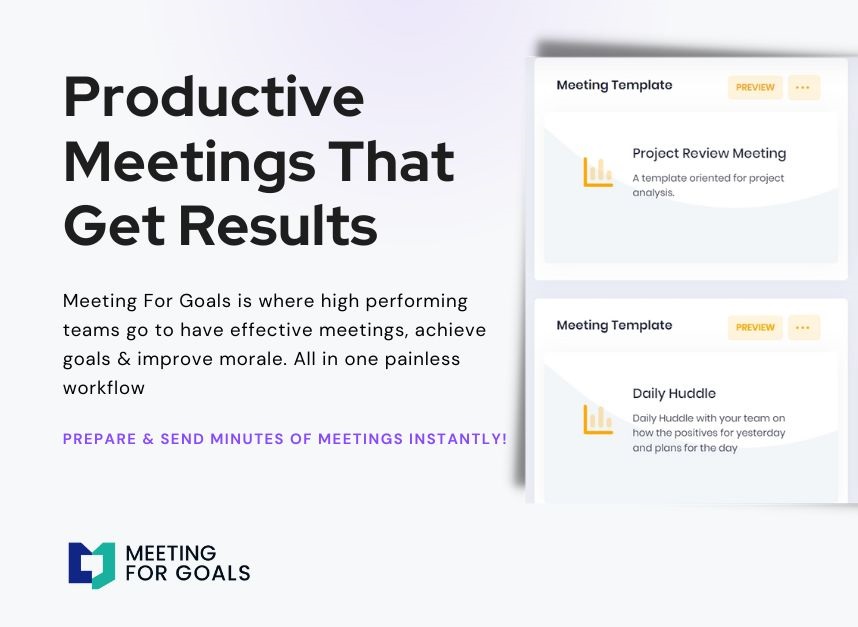
Let’s face it—managing meetings manually is a pain. That’s why we built Meeting For Goals: to help teams like yours run better meetings with less effort.
With our platform, you can:
- Build and share agendas in minutes
- Assign tasks during the meeting
- Generate minutes automatically
- Track follow-ups and accountability
It’s everything you need to turn meetings into momentum. Whether you’re running a daily standup or a quarterly strategy session, Meeting For Goals keeps your team aligned and on track. Ready to try it out? Sign up for free today.
VIII. Conclusion
Meetings shouldn’t be a time sink. With the right agenda and well-documented minutes, they become powerful tools for collaboration, alignment, and execution. For growing companies, especially those led by ambitious executives, improving meeting efficiency can unlock serious gains in performance and morale.
By using best practices—and the right tools—you can turn every meeting into a strategic advantage. Meeting For Goals helps you:
- Create focused, goal-driven agendas
- Run meetings that stay on track
- Document action items in real-time
- Keep your team accountable and aligned
Don’t let another meeting go to waste. 👉 Start your free trial now. Explore how high-performing teams are using Meeting For Goals to save time, hit targets, and boost morale—one meeting at a time. Explore more resources and templates at meetingforgoals.com.