
Retrospective Meeting in Agile: How to Make Every Retrospective Count with Meeting For Goals
Retrospective meetings are the heartbeat of continuous improvement in Agile teams. They offer a structured opportunity to reflect, learn, and adapt. This empowers teams to grow stronger with every sprint. However, without the right structure and tools, these meetings can easily become repetitive, unfocused, or worse—ignored altogether.
In this guide, we’ll show you how to run effective Agile retrospectives that spark real change. We aim to improve morale and align with your company’s big-picture goals. We will also explore how Meeting For Goals can help you turn every retrospective into a high-impact session that drives performance.
Ready to transform your retrospectives? Start by exploring our free meeting templates at Meeting For Goals Templates or sign up now to streamline your Agile meetings at Meeting For Goals Registration.
Introduction
In Agile project management, the retrospective meeting is a key ritual. Held at the end of each sprint, retrospectives give teams a chance to reflect on:
- What went well,
- What didn’t, and
- How to improve.
For growing companies—especially those with 40 to 70 employees—every meeting must count. Leaders like Directors, VPs, and C-suite executives often juggle multiple priorities. Inefficient meetings waste time, drain energy, and derail momentum.
That’s where Meeting For Goals comes in. It’s a meeting management platform designed for high-performing teams. With features like:
- Goal alignment,
- Structured agendas, and
- Built-in accountability,
it helps turn every meeting—including retrospectives—into a productive, strategic session.
In this article, we’ll cover everything you need to know about Agile retrospectives, including:
- The purpose and benefits,
- Who should attend,
- How to prepare and run the meeting,
- What to do afterward, and
- How Meeting For Goals enhances each step.
Let’s dive in.
2 Minute Video
Watch a 2 minute demo of our meeting management software in action
Section 1: Purpose of Retrospective Meetings
Retrospectives are more than just a team check-in. They’re a cornerstone of Agile that helps teams grow and adapt over time. Here’s why they matter.
Core Objectives: Reflect, Learn, and Improve
Every retrospective should focus on three main goals:
- Reflection – Look back at the sprint and evaluate what went well and what didn’t.
- Learning – Understand the root causes of successes and challenges.
- Adaptation – Turn insights into clear, actionable steps for the next sprint.
This cycle is key to Agile’s inspect-and-adapt philosophy. It ensures that teams are not just delivering work but improving how they work.
Improving Team Dynamics
Retrospectives also strengthen team relationships. They create a safe space for open dialogue, where team members can share feedback, voice concerns, and celebrate wins.
For example, if your team struggles with communication, a retrospective can surface that issue. You can then introduce changes—like daily stand-ups or clearer documentation—to fix it.
Boosting Project Success
When done right, retrospectives lead to:
- Fewer repeated mistakes,
- Faster delivery,
- Higher engagement, and
- Better alignment with business goals.
They’re a simple but powerful way to build momentum over time.
Tied to Agile Principles
The Agile Manifesto emphasizes continuous improvement: “At regular intervals, the team reflects on how to become more effective, then tunes and adjusts its behavior accordingly.” Retrospectives bring this value to life.
How Meeting For Goals Helps
Meeting For Goals makes retrospectives more impactful by:
- Linking meeting agendas directly to company goals,
- Tracking action items across sprints,
- Offering easy-to-use templates for structured discussions, and
- Sending reminders to ensure follow-through.
With Meeting For Goals, every retrospective becomes a stepping stone toward better performance and stronger alignment.
Want to learn more about how to run effective meetings? Visit Meeting For Goals.
Adding an Agenda
How to add an agenda instantly on Meeting For Goals
Section 2: Key Participants and Roles
A productive retrospective starts with the right people—and clear expectations.
Who Should Attend?
Here’s who should be in the room:
- Scrum Master (or Agile Coach): Facilitates the session and keeps it on track.
- Development Team: Shares feedback and collaborates on solutions.
- Product Owner (optional): Provides context and helps prioritize improvements.
- Stakeholders (occasionally): May join to offer outside perspectives, but sparingly.
Understanding Each Role
Scrum Master: Acts as a neutral facilitator. They guide the conversation, ensure everyone has a voice, and help the team stay focused.
Team Members: Bring insights from the sprint. They should come ready to share observations and suggestions.
Product Owner: Adds value by connecting team feedback to product goals. They can also help remove blockers identified during the meeting.
Fostering Psychological Safety
For honest feedback, the team needs to feel safe. That means:
- Setting ground rules (e.g., no blame, assume positive intent),
- Respecting all opinions, and
- Encouraging active listening.
A safe environment leads to open conversations—and real improvement.
How Meeting For Goals Helps
Meeting For Goals supports team collaboration by:
- Assigning roles before the meeting,
- Allowing anonymous feedback to encourage honesty,
- Structuring agendas to ensure balanced participation, and
- Tracking who’s responsible for each action item.
This clarity helps everyone show up prepared and engaged.
Section 3: Preparation for the Meeting
The secret to a great retrospective? Preparation.
Schedule It Right
Retrospectives should happen at the end of every sprint—ideally right after the sprint review. Best practices include:
- Use recurring calendar invites,
- Block 60–90 minutes, depending on team size, and
- Avoid scheduling back-to-back with other meetings.
Set a Clear Agenda
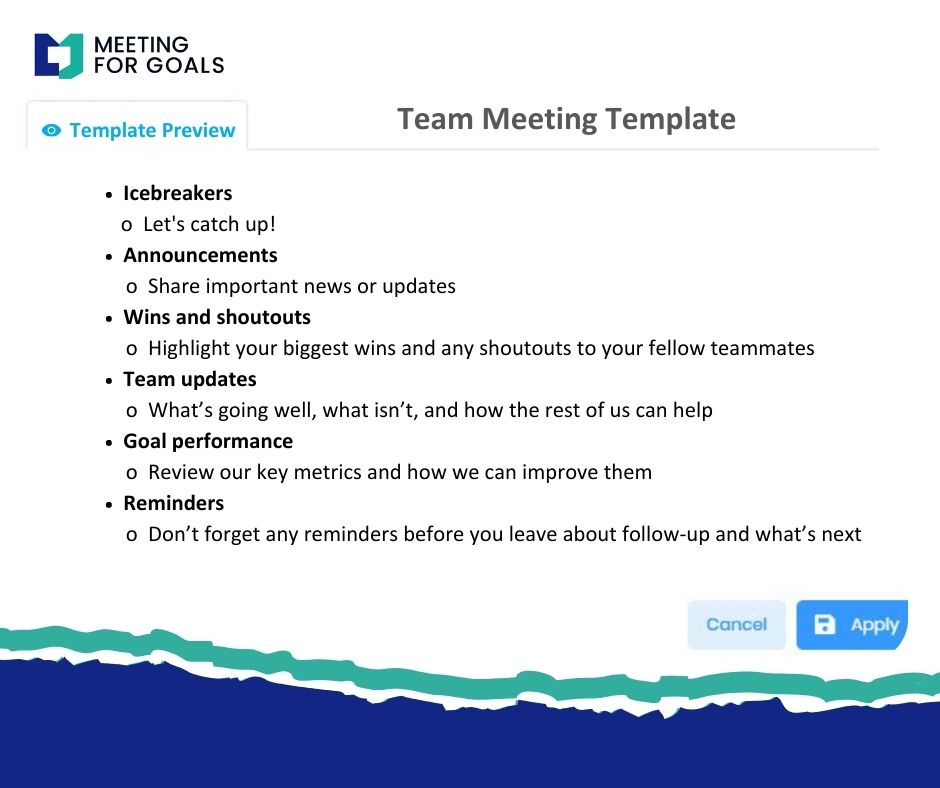
A good agenda keeps things focused. Here’s a simple format:
- Warm-up or check-in
- Review sprint goals and results
- Discuss what went well
- Discuss what didn’t go well
- Identify improvements
- Assign action items
Gather Data in Advance
Don’t rely on memory. Collect the following before the meeting:
- Sprint metrics (velocity, burndown charts),
- Feedback from team members (via surveys or forms), and
- Notes from previous retrospectives.
This helps the team focus on insights—not just recollections.
How Meeting For Goals Helps
Meeting For Goals simplifies prep work by:
- Auto-generating agendas using proven templates,
- Integrating with tools like Jira to pull in sprint data,
- Letting team members submit feedback in advance, and
- Highlighting unresolved action items from the last retrospective.
This ensures you walk into the meeting with everything you need to succeed.
Section 4: Conducting the Retrospective Meeting
Now it’s time to run the meeting. Here’s how to make it productive and engaging.
Step-by-Step Format
- Start with a Warm-Up – Use a quick icebreaker or check-in. It helps people shift from doing to reflecting.
- Review Sprint Goals and Data – What did the team aim to achieve? Did they meet those goals? Use charts or dashboards to visualize progress.
- Discuss What Went Well – Celebrate wins. Recognize team efforts. This boosts morale and reinforces good habits.
- Discuss What Didn’t Go Well – Be honest about challenges. Focus on processes—not people.
- Identify Improvements – Brainstorm ideas for change. Use frameworks like Start/Stop/Continue or 4Ls (Liked, Learned, Lacked, Longed For).
- Prioritize and Assign Action Items – Pick 1–3 high-impact changes. Assign owners and set deadlines.
Manage Your Time
Time-box each section to stay on track:
- Warm-up: 5–10 minutes
- Review: 10–15 minutes
- Discussions: 30–40 minutes
- Action items: 10–15 minutes
How Meeting For Goals Helps
Meeting For Goals keeps things moving with:
- Built-in timers for each agenda item,
- Live collaborative notes,
- Voting tools to prioritize ideas, and
- Auto-assignment of action items with due dates.
This structure ensures your retrospectives are focused, inclusive, and productive.
Want to try these tools for your next meeting? Sign up now.
Section 5: Following Up After the Retrospective
The meeting is over—but the work isn’t done.
Document Everything
Right after the meeting, record:
- Key takeaways,
- Action items with owners and deadlines, and
- Any changes to team processes.
Store this in a shared location so it’s easy to access later.
Track Progress
Review action items regularly—in daily stand-ups or sprint planning. This keeps improvement efforts alive and visible.
Avoid Common Pitfalls
- Don’t overload the team with too many tasks.
- Avoid vague action items—be specific.
- Make sure tasks are visible and trackable.
How Meeting For Goals Helps
Meeting For Goals ensures follow-through by:
- Saving all meeting notes automatically,
- Sending reminders to task owners,
- Integrating with tools like Jira and Asana, and
- Showing progress dashboards over time.
This keeps your team accountable—and on a path of continuous growth.
Want to explore more ways to improve your meetings? Check out our free meeting templates at Meeting For Goals Templates.
Conclusion
Agile retrospectives are a powerful tool for team improvement. They help you reflect, learn, and adapt—one sprint at a time.
But to be effective, retrospectives need structure, consistency, and follow-through. That’s where Meeting For Goals shines.
With Meeting For Goals, you can:
- Align retrospectives with strategic goals,
- Run focused, efficient meetings,
- Track action items and ensure accountability, and
- Save time and boost engagement.
Whether you’re a VP, Director, or team lead, you know how valuable your team’s time is. Don’t let another retrospective go to waste. Make every meeting count.
Ready to elevate your Agile retrospectives? Sign up today at Meeting For Goals and start running meetings that drive results.
For more tips, tools, and templates, visit Meeting For Goals.
Further Reading:
Learn more about Agile retrospectives from the Scrum Guide.
Discover the importance of psychological safety in teams from Google’s Project Aristotle.
Let’s make every retrospective a launchpad for success.