
Meeting Agenda Sample: A Roadmap for Productive Meetings
Inefficient meetings are more than just a time drain—they’re a productivity killer. For high-performing teams, every minute spent in a meeting needs to deliver value. That’s why a well-structured meeting agenda isn’t just helpful—it’s essential.
In this guide, you’ll learn how to craft an effective meeting agenda. You’ll get access to a downloadable template and discover how Meeting For Goals can help you turn your meetings into powerful tools for alignment, decision-making, and action.
👉 Ready to take control of your meetings? Sign up for Meeting For Goals today and start transforming your team’s workflow: https://app.meetingforgoals.com/TenantRegistration/Register
Let’s dive in.
I. Introduction
Meetings can either be a launchpad for progress or a black hole for time. When done right, they align teams, foster collaboration, and drive impactful decisions. But when they lack structure and purpose, they create confusion, drain energy, and stall momentum.
This is especially true for companies with 40 to 70 employees. Leaders like Directors, VPs, and C-suite executives need to ensure every meeting moves the needle. That’s where Meeting For Goals comes in.
Our platform helps you:
- Cut meeting times by up to 30%
- Focus discussions around business outcomes
- Improve team morale through clarity and accountability
This article is your complete guide to creating and using meeting agendas that actually work. Here’s what you’ll learn:
- Why meeting agendas matter more than ever
- The essential elements of every great agenda
- A sample template you can start using today
- Smart strategies for implementation
- How to make your meetings more productive using Meeting For Goals
Let’s get started.
2 Minute Video
Watch a 2 minute demo of our meeting management software in action
II. Understanding the Purpose of a Meeting Agenda
A meeting agenda is more than a checklist—it’s your blueprint for success. It provides your team with a clear direction, sets expectations, and helps everyone stay focused.
What is a Meeting Agenda?
Simply put, a meeting agenda is a document that lays out:
- What will be discussed
- Who will be involved
- How much time will be spent on each topic
- What outcomes are expected
It acts like a GPS for your meeting—keeping everyone on track and moving toward a shared destination.
Why Agendas Matter
Without an agenda, meetings can easily veer off course. Conversations drift, time gets wasted, and people leave feeling confused or unheard.
Here’s why agendas are critical:
- Improved Focus: Everyone knows what to prepare for.
- Time Efficiency: Meetings stay within their allotted time.
- Accountability: People know what they’re responsible for.
- Transparency: Everyone can see what’s being discussed and why.
According to a study by the Harvard Business Review, 71% of senior managers said meetings are unproductive and inefficient. A clear agenda is one of the easiest ways to fix that.
Common Meeting Goals
Before you write an agenda, ask: What’s the purpose of this meeting?
Here are some common goals:
- Alignment: Get everyone on the same page.
- Updates: Share progress or performance metrics.
- Decision-Making: Choose between options or set a direction.
- Problem-Solving: Collaborate to overcome challenges.
When your agenda supports a clear goal, your meeting becomes a tool for progress—not just a calendar filler.
Meeting For Goals makes it easy to define your meeting’s purpose and track outcomes over time. Learn more at https://meetingforgoals.com.
Adding an Agenda
How to add an agenda instantly on Meeting For Goals
III. Key Components of an Effective Meeting Agenda
Creating a good agenda isn’t hard—but it does take intention. Here are the seven components every agenda should include:
- Meeting Title and Purpose
Start with a clear meeting name and a short description of why you’re meeting.
Example:
- Title: “Q2 Marketing Strategy Review”
- Purpose: “To evaluate campaign performance and align on Q3 goals.”
This sets the tone and helps participants understand the meeting’s value.
- Date, Time, and Location
Include the basics:
- Date
- Start and end time
- Location or video link
This ensures everyone shows up on time and prepared.
- Participants and Roles
List who’s attending and what their roles are.
Example:
- Jane Doe – Facilitator
- Mark Lee – Presents campaign metrics
- Sarah Kim – Takes notes
This promotes accountability and encourages preparation.
- Objectives and Desired Outcomes
Spell out what you want to achieve.
Example:
- Objective: Finalize Q3 marketing budget
- Outcome: Agreement on budget allocations
When people know the goal, they’re more likely to stay focused.
- Agenda Items with Time Blocks
Break the meeting into chunks. Assign a time limit to each item.
Example:
- 10:00–10:10 – Welcome and agenda review
- 10:10–10:30 – Campaign performance update
- 10:30–10:50 – Budget discussion
- 10:50–11:00 – Action items and wrap-up
This keeps the meeting on track and ensures balanced discussion.
- Supporting Materials
Attach or link to any documents participants need to review beforehand.
Examples:
- Performance dashboards
- Budget proposals
- Slide decks
This helps everyone come prepared and ready to contribute.
- Action Items and Follow-Up
End every meeting by summarizing:
- What decisions were made
- Who’s responsible for what
- Deadlines and next steps
Meeting For Goals allows you to document and assign action items in real time—so nothing falls through the cracks.
IV. Sample Meeting Agenda Template
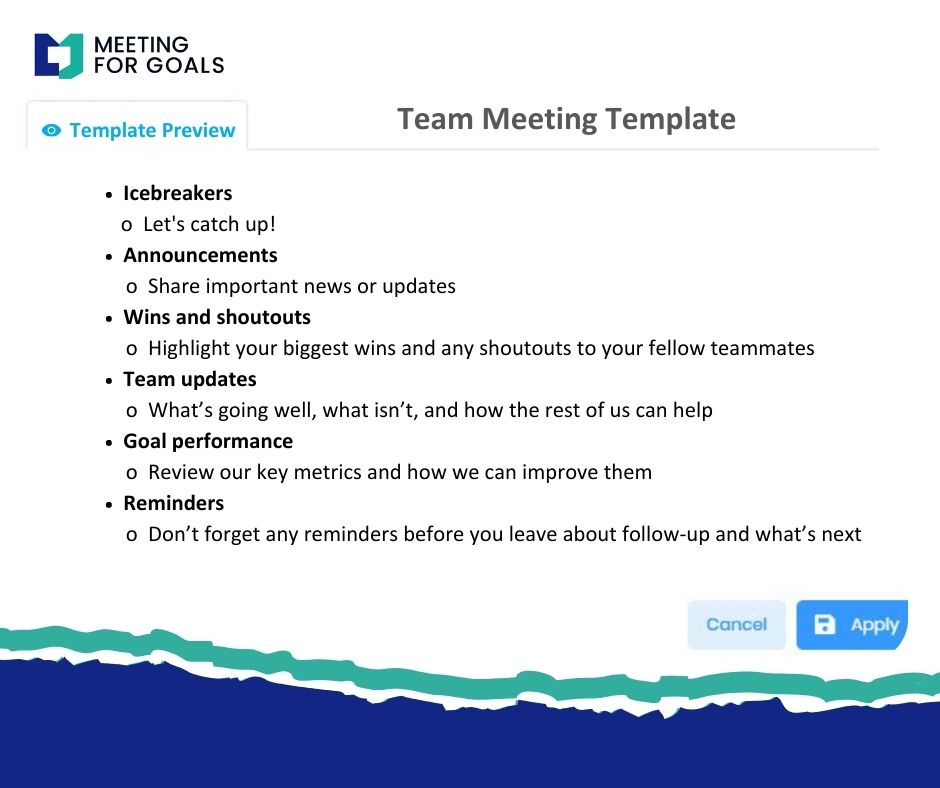
Here’s a sample agenda you can start using today. It’s designed for a weekly marketing team sync but can be adapted for any team or department.
Sample Agenda: Weekly Marketing Team Meeting
- Meeting Title: Weekly Marketing Sync
- Date: Monday, March 25, 2024
- Time: 10:00 AM – 11:00 AM
- Location: Zoom (link provided)
- Facilitator: Jane Doe, VP of Marketing
- Note-Taker: Alex Rivera
Meeting Objectives:
- Review campaign progress
- Address current challenges
- Set goals for the upcoming week
Agenda Items:
-
Welcome and Agenda Overview (10:00–10:05)
- Quick check-in and meeting goals
-
Campaign Performance Updates (10:05–10:25)
- Team leads present key metrics
-
Challenges and Roadblocks (10:25–10:40)
- Open discussion to troubleshoot issues
-
Upcoming Initiatives (10:40–10:55)
- Preview next week’s campaigns
-
Action Items and Wrap-Up (10:55–11:00)
- Recap decisions and assign tasks
Supporting Materials:
- Weekly performance dashboard
- Campaign metrics report (attached)
Want more templates like this? Check out our free meeting templates library: https://meetingforgoals.com/meeting_templates
V. Strategies for Implementing and Adapting the Agenda
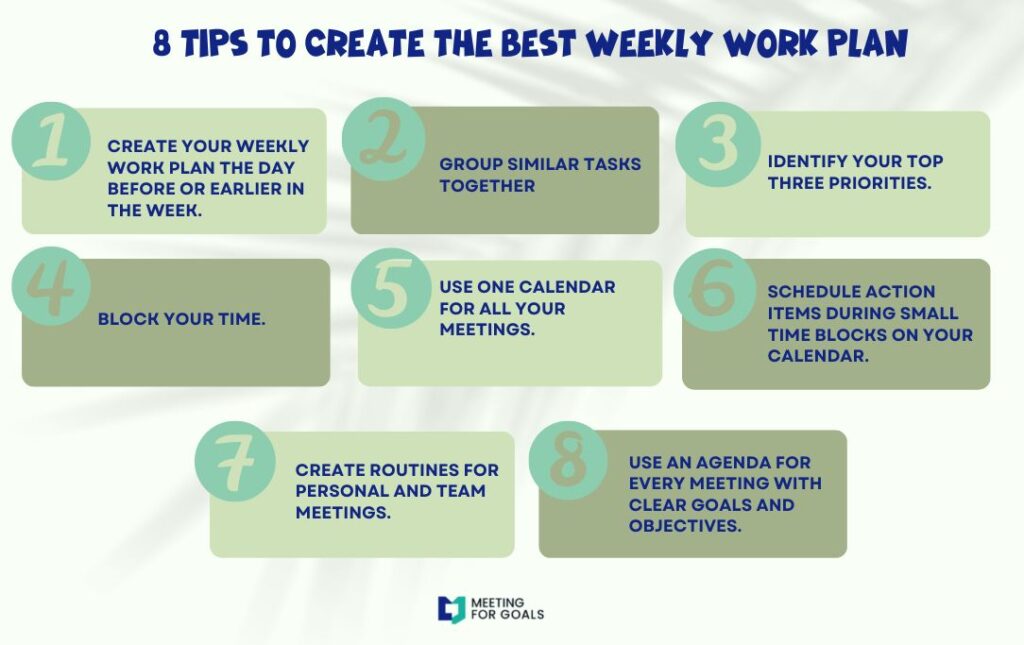
Having a great agenda is one thing. Using it well is another. Here are some practical tips to make agendas a regular part of your meeting culture.
- Send Agendas in Advance
Share the agenda at least 24–48 hours before the meeting. This gives people time to review materials and prepare their thoughts.
With Meeting For Goals, you can automate agenda distribution and even see who’s viewed it.
- Invite Input from the Team
Let team members suggest agenda items. This builds engagement and ensures important topics aren’t missed.
Use a shared document or collaborative tool to gather suggestions before finalizing the agenda.
- Respect the Time Blocks
Stick to the time limits you’ve set. If a topic runs long, schedule a follow-up rather than letting it derail the meeting.
This shows respect for everyone’s time and builds trust.
- Facilitate with Purpose
The facilitator should keep things moving, redirect off-topic discussions, and ensure everyone’s voice is heard.
Use the agenda as a guide—not a script.
- Capture Action Items on the Spot
As decisions are made, assign tasks immediately. Don’t wait until after the meeting.
Meeting For Goals lets you assign action items in real time, track progress, and send reminders.
- Review and Improve
After the meeting, ask for feedback. What worked? What didn’t?
Use that input to refine your agenda for next time. Over time, you’ll build a meeting rhythm that works for your team.
VI. Additional Tips for Better Meetings
Want to take your meetings to the next level? Here are a few more best practices:
- Limit Meeting Length: Keep meetings under 60 minutes when possible.
- Use Visuals: Charts, dashboards, and slides can help clarify complex topics.
- Start and End on Time: Punctuality sets the tone and builds discipline.
- Follow Up: Send a summary email with key takeaways and action items.
For more expert advice, check out this article from Forbes on how to run effective meetings: https://www.forbes.com/sites/forbescoachescouncil/2021/02/25/15-tips-for-running-more-effective-meetings
VII. Conclusion
Meetings don’t have to be a waste of time. With a clear agenda, they become a powerful way to align your team, solve problems, and drive results.
By understanding the purpose of an agenda, using the right structure, and implementing it consistently, you can create a meeting culture that supports your business goals.
Meeting For Goals is built to help you do just that. From agenda creation and time tracking to action item follow-up, our platform makes meetings more efficient and results-driven.
👉 Ready to transform your meetings? Sign up now at https://app.meetingforgoals.com/TenantRegistration/Register
Want more tools to run better meetings? Explore our free templates at https://meetingforgoals.com/meeting_templates
Let’s make every meeting count. Learn more at https://meetingforgoals.com
Word Count: Approx. 2,100 words.